
 HƯỚNG DẪN ĐĂNG KÝ THÀNH VIÊN THƯỜNG
BỘ Giáo án phụ đạo tiếng anh 7 global success HỌC KÌ 1 + HỌC KÌ 2 NĂM 2023 - 2024 được soạn dưới dạng file word gồm 2 FILE trang. Các bạn xem và tải giáo an phụ đạo tiếng anh 7 global success , giáo án phụ đạo tiếng anh 7 học kì 1, giáo án phụ đạo tiếng anh 7 học kì 2 ...về ở dưới.
Tháng 9
Buổi 1
I. Objectives: By the end of the lesson, ss will be able to:
1. Knowledge:
- Vocab: revision vocabulary unit 1
-Language: Practice doing exercises using the grammar points in Unit 1
2 Skills: R, W, S, L
3. Attitude and compentencies: Ss have apossitive attitude toward what they have learnt
Form and improve such competencies as: collaboration,communication,presentation, teamwork
II. Preparations:
Teacher: posters
Students: Text book
III. Contents:
A. VERB FOLLOWED BY GERUND (ĐỘNG TỪ THEO SAU BỞI V-ING)
Cấu trúc: S + like/ love/ enjoy/ hate +V-ing
Ví dụ:
I like swimming. (Tôi thích bơi lội.)
She hates washing clothes. (Cô ấy ghét giặt quần áo.)
My father doesn't like mountain - climbing. (Bố tôi không thích leo núi.)
Ngoài ra, sau những động từ chỉ sở thích này chúng ta cũng có thể dùng to - infinitive mà nghĩa của câu không hề thay đổi.
Ví dụ:
My sister loves to make model. (Chị gái tôi thích công việc làm người mẫu.)
B. Vocabulary
1. a piece of cake (idiom) / əpi:s əv keɪk /: dễ ợt
2. arranging flowers /ə'reɪndʒɪŋ 'flaʊər/: cắm hoa
3. bird-watching / bɜːd wɒtʃɪŋ /: quan sát chim chóc
4. board game /bɔːd ɡeɪm /: trò chơi trên bàn cờ (cờ tỉ phú, cờ vua)
5. carve (v) / kɑːv /: chạm, khắc
6. carved (adj) / kɑːvd /: được chạm, khắc
7. collage / 'kɒlɑːʒ /: một bức tranh tạo thành từ nhiều tranh, ảnh nhỏ
8. eggshell / eɡʃel /: vỏ trứng
9. fragile (adj) / 'frædʒaɪl /: dễ vỡ
10. gardening / 'ɡɑːdənɪŋ /: làm vườn
11. horse-riding / hɔːs, 'raɪdɪŋ /: cưỡi ngựa
12. ice-skating / aɪs, 'skeɪtɪŋ /: trượt băng
13. making model / 'meɪkɪŋ, 'mɒdəl /: làm mô hình
14. making pottery / 'meɪkɪŋ 'pɒtəri /: nặn đồ gốm
15. melody / 'melədi /: giai điệu
16. monopoly / mə'nɒpəli /: cờ tỉ phú
17. mountain climbing / 'maʊntɪn, 'klaɪmɪŋ /: leo núi
18. share (v) / ʃeər /: chia sẻ
19. skating / 'skeɪtɪŋ /: trượt pa tanh
20. strange (adj) / streɪndʒ /: lạ
21. surfing / 'sɜːfɪŋ /: lướt sóng
22. unique (adj) / jʊˈni:k /: độc đáo
23. unusual (adj) / ʌn'ju:ʒuəl /: khác thường
C. EX1: Choose the best answer
1. Ann (hates, hate) playing games. She doesn’t (like, likes) playing volleyball.
2 .Mr Brown (enjoys, enjoy) reading books a lot. He (likes, like) reading stories, too.
3. We (like, likes) playing table tennis. They (like, likes) playing table tennis, too.
4. I (dislike, dislikes) eating durians but I (like, likes) eating mangoes a lot.
5. They (hate, hates) cleaning the foor but we (love, loves) cleaning the floor
6. I don’t (likes, like) people shouting at me. She doesn’t (like, likes) people shouting at her, either.
7. I love (meet, meeting) people. He (loves, love) meeting people, too.
8 .Tom doesn’t (minds, mind) working at night. They don’t (mind, minds) working either.
9. I enjoy (being, be) alone. Thanh doesn’t (enjoy, enjoys) being alone.
10. He’s not very fond of (doing, do) the housework.
EX2:Choose the word that has the underlined part pronounced differently from the others.
1.A. singer B. surprise C. colour D. bird
2.A. picture B. heard C. Thursday D. nurse
3.A. term B. shirt C. cupboard D. first
4.A. carrot B. girl C. away D. common
5.A. collect B. surf C. learn D. birth
EX3: Complete the sentences , using the –ING the form of verb:
I really enjoy …………. (paint) funny pictures of people.
You need ………… (work) hard if you want to be a professional dancer.
Don’t worry. I ……………. (go) swimming with you tomorrow.
Will you take up………….. (make) pottery in the future?
I enjoy……………. (fish) because it ………. (be) relaxing.
Ngoc …..(love) cartoons, but she says she …….. (not continue) this hobby in the future.
His hobby is ……….(collect) toy cars.
Do you think you ………(meet) An this week? – I’m not sure.
I find this hobby …………. (relax) and I feel much better.
When you ……….(start) making architectural models?
1. Fill in the blank with a word/ phrase in the box.
My favourite hobby is (1) and I like so much (2) new plants and (3) them in daily morning. I enjoy seeing flowers (4) and plants (5) . I really (6) sense of great achievements and realize the fact of life. It helps me keep (7) fit, (8) , strong and (9) . Watering plants and gardening on daily basis is a best (10) for me which positively moulds my mind and body.
2. Choose the correct answer A, B, C or D to fill each blank in the following passage.
My favourite hobby is coin (1) . It is also one of the oldest (2) of the world and is also called 'hobby of the Kings', as in the old times, it was only done by kings and elite class of the society. It started for me some years back when my father used to come back (3) his foreign tours and give me coins of (4) countries. I started collecting them in my money box and after that I always used to wait for my new coins as much I used to wait for my father. Since then, it has become my favourite hobby. This hobby has given me information about different countries of the world. I feel extreme pleasure in (5) my collection to (6) . It has also taught me this lesson that A LIFE (7) A HOBBY IS JUST (8) FOOD WITHOUT SALT.
1. A. collecting B. collection C. collected D. collectors
2. A. hobby B. hobbies C. game D. games
3. A. after B. in C. from D. of
4. A. other B. different C. unlike D. diverse
5. A. showing B. show C. shown D. to show
6. A. other B. another C. others D. person
7. A. with B. about C. without D. of
8. A. as B. like C. if D. likes
Buổi 2
I. Objectives: By the end of the lesson, ss will be able to:
1. Knowledge:
-Language: Practice doing exercises using the grammar points in Unit 1: Present simple.
2 Skills: R, W, S, L
3. Attitude and compentencies: Ss have a possitive attitude toward what they have learnt
Form and improve such competencies as: collaboration,communication,presentation, teamwork
II. Preparations:
Teacher: posters
Students: Text book
III. Contents:
GRAMMAR
I. THE PRESENT SIMPLE - Thì hiện tại đơn
1. Cấu trúc thì hiện tại đơn với động từ "To be"
1.1 Câu khẳng định
S + is/ am/ are + ...
- Trong đó: S (subject) = Chủ ngữ
CHÚ Ý:
- Khi S = I + am
- Khi S = He/ She/ It + is
- Khi S = We/ You/ They + are
Ex:I am a student. (Tôi là sinh viên.)
Ta thấy với chủ ngữ khác nhau động từ "to be" chia khác nhau.
1.2 Câu phủ định
S + is/ am/ are + not + ...
Ex: He isn’t my little brother. (Cậu ấy không phải là em trai của tôi.)
1.3 Câu nghi vấn
Am/ Is/ Are + S+ ...?
Trả lời: Yes, I + am. - Yes, he/ she/ it + is. - Yes, we/ you/ they + are.
No, I + am not. - No, he/ she/ it + isn't - No, we/ you/ they + aren't.
Ex: Are you Jananese? (Bạn là người Nhật đúng không vậy?)
- No, I am not. I'm Vietnamese. (Không. Tôi là người Việt Nam.)
2. Cấu trúc thì hiện tại đơn với động từ thường
2.1 Câu khẳng định
S + V(s/es)
Trong đó: - S (subject) = Chủ ngữ
- V (verb) = Động từ
Ex:We go to school by bus everyday. (Chúng tôi đến trường bằng xe buýt hàng ngày.)
Trong câu này, chủ ngữ là "She" nên động từ chính "go" phải thêm "es".
2.2 Câu phủ định
S + don't/ doesn't + V(nguyên thể)
EX:I don't usually go swimming. (Tôi không thường xuyên đi bơi.)
- She doesn't like football. (Cô ấy không thích bóng đá.)
2.3 Câu nghi vấn
Do/ Does + S + V(nguyên thể)?
Trả lời: Yes, I/we/you/they + do./ Yes, he/she/it + does.
No, I/we/you/they + don't/ No, he/she/it + doesn't.
Ex: Do you stay with your family? (Bạn có ở cùng với gia đình không?)
Yes, I do./ No, I don't. (Có, tớ ở cùng với gia đình./ Không, tớ không ở cùng.)
Trong câu này, chủ ngữ là "you" nên ta mượn trợ động từ "Do" đứng trước chủ ngữ, động từ chính "stay" ở dạng nguyên thể.
Does your mother like cooking? (Mẹ của bạn có thích nấu ăn không?)
Yes, she does./ No, she doesn't. (Có, bà ấy thích nấu ăn./ Không, bà ấy không thích.)
Trong câu này, chủ ngữ là "your mother" (tương ứng với ngôi "she") nên ta mượn trợ động từ "Does" đứng trước chủ ngữ, động từ chính "like" ở dạng nguyên thể.
3. Cách sử dụng thì hiện tại đơn
- Diễn tả một hành động, sự việc diễn ra thường xuyên, lặp đi lặp lại hay một thói quen.
Ví dụ:They drive to the office every day. (Hàng ngày họ lái xe đi làm.)
She doesn’t come here very often. (Cô ấy không đến đây thường xuyên.)
Diễn tể một sự thật hiển nhiên, một chân lý
Ví dụ: The sun rises in the East and sets in the West. (Mặt trời mọc ở đằng Đông, và lặn ở đằng Tây.)
Diễn tả sự việc sẽ xảy xa theo lịch trình, thời gian biểu rõ ràng như giờ tàu, máy bay chạy...
Ví dụ: The flight starts at 7 am tomorrow. Diễn tả suy nghĩ, cảm xúc, cảm giác.
Ví dụ: I think he is a good boy. (Tôi nghĩ cậu ấy là một chàng trai tốt.)
- She feels very tired now. (Bây giờ cô ấy cảm thấy rất mệt.)
4. Dấu hiệu nhận biết thì hiện tại đơn
-Trong câu có các trạng từ chỉ tần suất:
Chú ý: từ “ba lần” trở lên sử dụng: số đếm + times
Ví dụ: She sees grandparents four times a month. (Cô ấy đến thăm ông bà 1 tháng 4 lần.)
-Vị trí của trạng từ chỉ tuần suất trong câu:
- Các trạng từ: always, usually, often, sometimes, rarely, seldom... - đứng trước động từ thường, đứng sau động từ "to be" và trợ động từ.
Ví dụ: He is usually at home in the evening. (Anh ấy thường ở nhà vào buổi tối.)
-I don't often go out with my friends. (Tôi không thường xuyên ra ngoài với bạn bè.)
5. Quy tắc thêm "s" hoặc "es" sau động từ
Thông thường ta thêm "s" vào sau các động từ.
work - works read - reads
like - likes dance - dances
Những động từ tận cùng bằng: -s; -sh; -ch; -z; -x; -o ta thêm "es".
miss - misses watch - watches
wash - washes buzz - buzzes
Những động từ tận cùng là "y":
+ Nếu trước "y" là một nguyên âm (a, e, i, o, u) - ta giữ nguyên "y" + "s"
play - plays; buy - buys; pay - pays
+ Nếu trước "y" là một phụ âm - ta đổi "y" thành "i" + "es"
fly - flies; cry - cries; fry - fries
Trường hợp đặc biệt:
Ta có: have - has
Động từ "have" khi đi với chủ ngữ là ngôi thứ 3 số ít sẽ không thêm "s" mà biến đổi thành "has".
Ví dụ: She has three cats. (Cô ấy có 3 con mèo.)
1. Make up sentences using the words and phrases given.
2. Write complete sentences using the prompts given.
HỌC KÌ 1
HỌC KÌ 2
THẦY CÔ TẢI NHÉ!
Tháng 9
Buổi 1
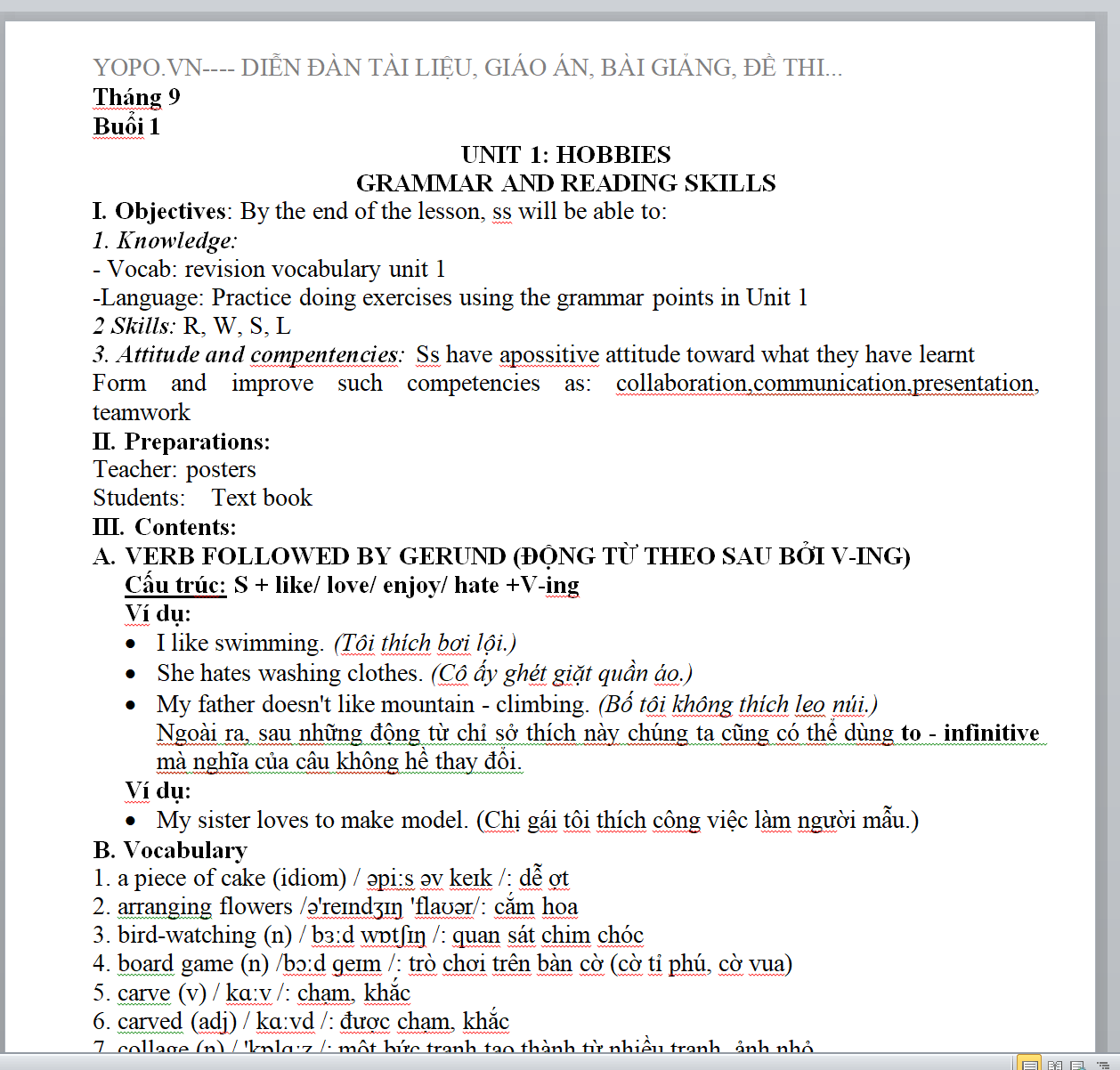
UNIT 1: HOBBIES
GRAMMAR AND READING SKILLS
GRAMMAR AND READING SKILLS
I. Objectives: By the end of the lesson, ss will be able to:
1. Knowledge:
- Vocab: revision vocabulary unit 1
-Language: Practice doing exercises using the grammar points in Unit 1
2 Skills: R, W, S, L
3. Attitude and compentencies: Ss have apossitive attitude toward what they have learnt
Form and improve such competencies as: collaboration,communication,presentation, teamwork
II. Preparations:
Teacher: posters
Students: Text book
III. Contents:
A. VERB FOLLOWED BY GERUND (ĐỘNG TỪ THEO SAU BỞI V-ING)
Cấu trúc: S + like/ love/ enjoy/ hate +V-ing
Ví dụ:
I like swimming. (Tôi thích bơi lội.)
She hates washing clothes. (Cô ấy ghét giặt quần áo.)
My father doesn't like mountain - climbing. (Bố tôi không thích leo núi.)
Ngoài ra, sau những động từ chỉ sở thích này chúng ta cũng có thể dùng to - infinitive mà nghĩa của câu không hề thay đổi.
Ví dụ:
My sister loves to make model. (Chị gái tôi thích công việc làm người mẫu.)
B. Vocabulary
1. a piece of cake (idiom) / əpi:s əv keɪk /: dễ ợt
2. arranging flowers /ə'reɪndʒɪŋ 'flaʊər/: cắm hoa
3. bird-watching
/ bɜːd wɒtʃɪŋ /: quan sát chim chóc4. board game
/bɔːd ɡeɪm /: trò chơi trên bàn cờ (cờ tỉ phú, cờ vua)5. carve (v) / kɑːv /: chạm, khắc
6. carved (adj) / kɑːvd /: được chạm, khắc
7. collage
/ 'kɒlɑːʒ /: một bức tranh tạo thành từ nhiều tranh, ảnh nhỏ8. eggshell
/ eɡʃel /: vỏ trứng9. fragile (adj) / 'frædʒaɪl /: dễ vỡ
10. gardening
/ 'ɡɑːdənɪŋ /: làm vườn11. horse-riding
/ hɔːs, 'raɪdɪŋ /: cưỡi ngựa12. ice-skating
/ aɪs, 'skeɪtɪŋ /: trượt băng13. making model / 'meɪkɪŋ, 'mɒdəl /: làm mô hình
14. making pottery / 'meɪkɪŋ 'pɒtəri /: nặn đồ gốm
15. melody / 'melədi /: giai điệu
16. monopoly
/ mə'nɒpəli /: cờ tỉ phú17. mountain climbing
/ 'maʊntɪn, 'klaɪmɪŋ /: leo núi18. share (v) / ʃeər /: chia sẻ
19. skating
/ 'skeɪtɪŋ /: trượt pa tanh20. strange (adj) / streɪndʒ /: lạ
21. surfing
/ 'sɜːfɪŋ /: lướt sóng22. unique (adj) / jʊˈni:k /: độc đáo
23. unusual (adj) / ʌn'ju:ʒuəl /: khác thường
C. EX1: Choose the best answer
1. Ann (hates, hate) playing games. She doesn’t (like, likes) playing volleyball.
2 .Mr Brown (enjoys, enjoy) reading books a lot. He (likes, like) reading stories, too.
3. We (like, likes) playing table tennis. They (like, likes) playing table tennis, too.
4. I (dislike, dislikes) eating durians but I (like, likes) eating mangoes a lot.
5. They (hate, hates) cleaning the foor but we (love, loves) cleaning the floor
6. I don’t (likes, like) people shouting at me. She doesn’t (like, likes) people shouting at her, either.
7. I love (meet, meeting) people. He (loves, love) meeting people, too.
8 .Tom doesn’t (minds, mind) working at night. They don’t (mind, minds) working either.
9. I enjoy (being, be) alone. Thanh doesn’t (enjoy, enjoys) being alone.
10. He’s not very fond of (doing, do) the housework.
EX2:Choose the word that has the underlined part pronounced differently from the others.
1.A. singer B. surprise C. colour D. bird
2.A. picture B. heard C. Thursday D. nurse
3.A. term B. shirt C. cupboard D. first
4.A. carrot B. girl C. away D. common
5.A. collect B. surf C. learn D. birth
EX3: Complete the sentences , using the –ING the form of verb:
I really enjoy …………. (paint) funny pictures of people.
You need ………… (work) hard if you want to be a professional dancer.
Don’t worry. I ……………. (go) swimming with you tomorrow.
Will you take up………….. (make) pottery in the future?
I enjoy……………. (fish) because it ………. (be) relaxing.
Ngoc …..(love) cartoons, but she says she …….. (not continue) this hobby in the future.
His hobby is ……….(collect) toy cars.
Do you think you ………(meet) An this week? – I’m not sure.
I find this hobby …………. (relax) and I feel much better.
When you ……….(start) making architectural models?
III: READING
1. Fill in the blank with a word/ phrase in the box.
My favourite hobby is (1) and I like so much (2) new plants and (3) them in daily morning. I enjoy seeing flowers (4) and plants (5) . I really (6) sense of great achievements and realize the fact of life. It helps me keep (7) fit, (8) , strong and (9) . Watering plants and gardening on daily basis is a best (10) for me which positively moulds my mind and body.
2. Choose the correct answer A, B, C or D to fill each blank in the following passage.
My favourite hobby is coin (1) . It is also one of the oldest (2) of the world and is also called 'hobby of the Kings', as in the old times, it was only done by kings and elite class of the society. It started for me some years back when my father used to come back (3) his foreign tours and give me coins of (4) countries. I started collecting them in my money box and after that I always used to wait for my new coins as much I used to wait for my father. Since then, it has become my favourite hobby. This hobby has given me information about different countries of the world. I feel extreme pleasure in (5) my collection to (6) . It has also taught me this lesson that A LIFE (7) A HOBBY IS JUST (8) FOOD WITHOUT SALT.
1. A. collecting B. collection C. collected D. collectors
2. A. hobby B. hobbies C. game D. games
3. A. after B. in C. from D. of
4. A. other B. different C. unlike D. diverse
5. A. showing B. show C. shown D. to show
6. A. other B. another C. others D. person
7. A. with B. about C. without D. of
8. A. as B. like C. if D. likes
Principal’s signature:
Lê Thị Thanh Hương
Lê Thị Thanh Hương
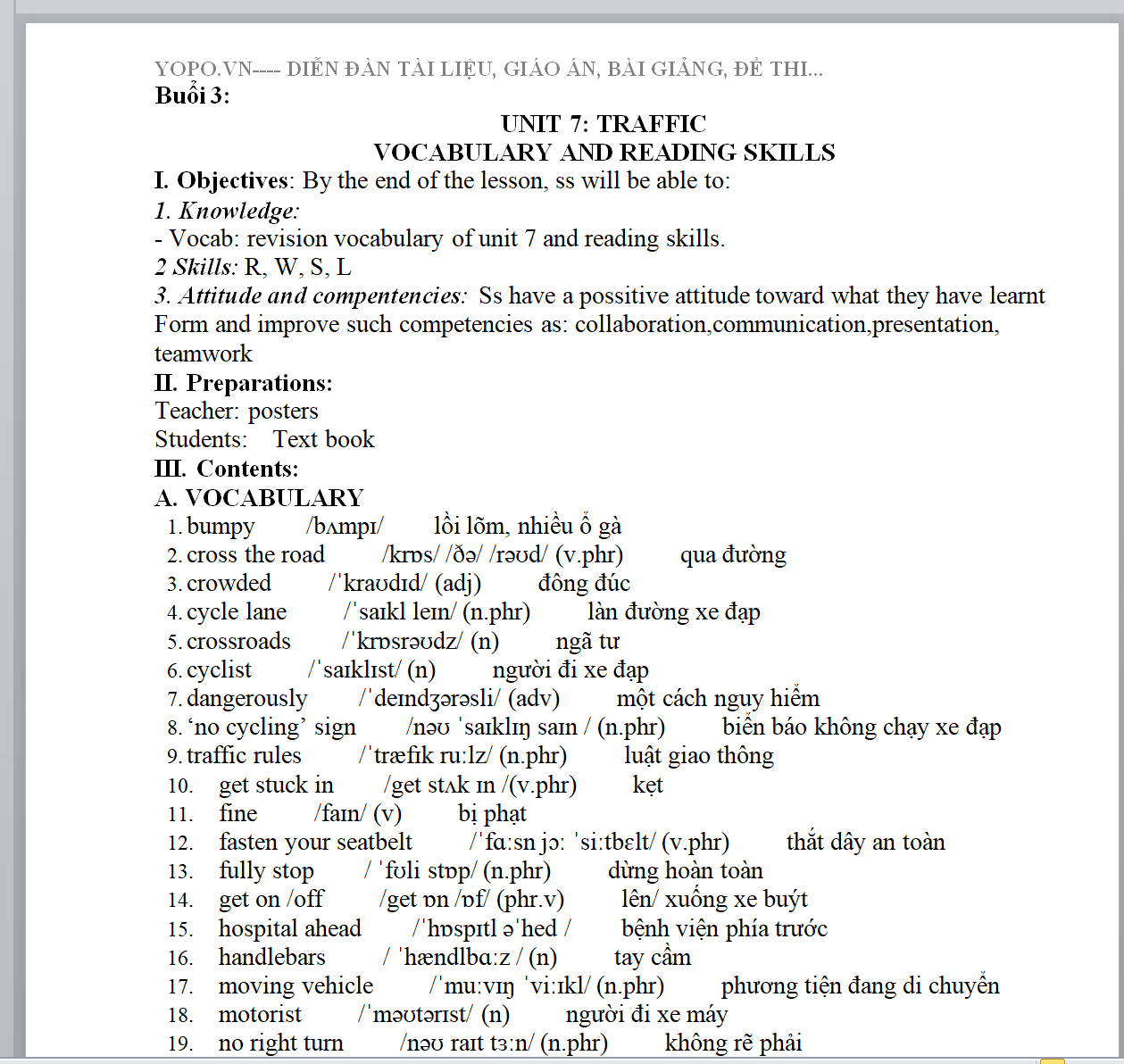
Buổi 2
UNIT 1: HOBBIES
PRESENT SIMPLE AND WRITING SKILLS
PRESENT SIMPLE AND WRITING SKILLS
I. Objectives: By the end of the lesson, ss will be able to:
1. Knowledge:
-Language: Practice doing exercises using the grammar points in Unit 1: Present simple.
2 Skills: R, W, S, L
3. Attitude and compentencies: Ss have a possitive attitude toward what they have learnt
Form and improve such competencies as: collaboration,communication,presentation, teamwork
II. Preparations:
Teacher: posters
Students: Text book
III. Contents:
GRAMMAR
I. THE PRESENT SIMPLE - Thì hiện tại đơn
1. Cấu trúc thì hiện tại đơn với động từ "To be"
1.1 Câu khẳng định
S + is/ am/ are + ...
- Trong đó: S (subject) = Chủ ngữ
CHÚ Ý:
- Khi S = I + am
- Khi S = He/ She/ It + is
- Khi S = We/ You/ They + are
Ex:I am a student. (Tôi là sinh viên.)
Ta thấy với chủ ngữ khác nhau động từ "to be" chia khác nhau.
1.2 Câu phủ định
S + is/ am/ are + not + ...
Ex: He isn’t my little brother. (Cậu ấy không phải là em trai của tôi.)
1.3 Câu nghi vấn
Am/ Is/ Are + S+ ...?
Trả lời: Yes, I + am. - Yes, he/ she/ it + is. - Yes, we/ you/ they + are.
No, I + am not. - No, he/ she/ it + isn't - No, we/ you/ they + aren't.
Ex: Are you Jananese? (Bạn là người Nhật đúng không vậy?)
- No, I am not. I'm Vietnamese. (Không. Tôi là người Việt Nam.)
2. Cấu trúc thì hiện tại đơn với động từ thường
2.1 Câu khẳng định
S + V(s/es)
Trong đó: - S (subject) = Chủ ngữ
- V (verb) = Động từ
Ex:We go to school by bus everyday. (Chúng tôi đến trường bằng xe buýt hàng ngày.)
Trong câu này, chủ ngữ là "She" nên động từ chính "go" phải thêm "es".
2.2 Câu phủ định
S + don't/ doesn't + V(nguyên thể)
EX:I don't usually go swimming. (Tôi không thường xuyên đi bơi.)
- She doesn't like football. (Cô ấy không thích bóng đá.)
2.3 Câu nghi vấn
Do/ Does + S + V(nguyên thể)?
Trả lời: Yes, I/we/you/they + do./ Yes, he/she/it + does.
No, I/we/you/they + don't/ No, he/she/it + doesn't.
Ex: Do you stay with your family? (Bạn có ở cùng với gia đình không?)
Yes, I do./ No, I don't. (Có, tớ ở cùng với gia đình./ Không, tớ không ở cùng.)
Trong câu này, chủ ngữ là "you" nên ta mượn trợ động từ "Do" đứng trước chủ ngữ, động từ chính "stay" ở dạng nguyên thể.
Does your mother like cooking? (Mẹ của bạn có thích nấu ăn không?)
Yes, she does./ No, she doesn't. (Có, bà ấy thích nấu ăn./ Không, bà ấy không thích.)
Trong câu này, chủ ngữ là "your mother" (tương ứng với ngôi "she") nên ta mượn trợ động từ "Does" đứng trước chủ ngữ, động từ chính "like" ở dạng nguyên thể.
3. Cách sử dụng thì hiện tại đơn
- Diễn tả một hành động, sự việc diễn ra thường xuyên, lặp đi lặp lại hay một thói quen.
Ví dụ:They drive to the office every day. (Hàng ngày họ lái xe đi làm.)
She doesn’t come here very often. (Cô ấy không đến đây thường xuyên.)
Diễn tể một sự thật hiển nhiên, một chân lý
Ví dụ: The sun rises in the East and sets in the West. (Mặt trời mọc ở đằng Đông, và lặn ở đằng Tây.)
Diễn tả sự việc sẽ xảy xa theo lịch trình, thời gian biểu rõ ràng như giờ tàu, máy bay chạy...
Ví dụ: The flight starts at 7 am tomorrow. Diễn tả suy nghĩ, cảm xúc, cảm giác.
Ví dụ: I think he is a good boy. (Tôi nghĩ cậu ấy là một chàng trai tốt.)
- She feels very tired now. (Bây giờ cô ấy cảm thấy rất mệt.)
4. Dấu hiệu nhận biết thì hiện tại đơn
-Trong câu có các trạng từ chỉ tần suất:
Chú ý: từ “ba lần” trở lên sử dụng: số đếm + times
Ví dụ: She sees grandparents four times a month. (Cô ấy đến thăm ông bà 1 tháng 4 lần.)
-Vị trí của trạng từ chỉ tuần suất trong câu:
- Các trạng từ: always, usually, often, sometimes, rarely, seldom... - đứng trước động từ thường, đứng sau động từ "to be" và trợ động từ.
Ví dụ: He is usually at home in the evening. (Anh ấy thường ở nhà vào buổi tối.)
-I don't often go out with my friends. (Tôi không thường xuyên ra ngoài với bạn bè.)
5. Quy tắc thêm "s" hoặc "es" sau động từ
Thông thường ta thêm "s" vào sau các động từ.
work - works read - reads
like - likes dance - dances
Những động từ tận cùng bằng: -s; -sh; -ch; -z; -x; -o ta thêm "es".
miss - misses watch - watches
wash - washes buzz - buzzes
Những động từ tận cùng là "y":
+ Nếu trước "y" là một nguyên âm (a, e, i, o, u) - ta giữ nguyên "y" + "s"
play - plays; buy - buys; pay - pays
+ Nếu trước "y" là một phụ âm - ta đổi "y" thành "i" + "es"
fly - flies; cry - cries; fry - fries
Trường hợp đặc biệt:
Ta có: have - has
Động từ "have" khi đi với chủ ngữ là ngôi thứ 3 số ít sẽ không thêm "s" mà biến đổi thành "has".
Ví dụ: She has three cats. (Cô ấy có 3 con mèo.)
IV. WRITING
1. Make up sentences using the words and phrases given.
2. Write complete sentences using the prompts given.
HỌC KÌ 1
HỌC KÌ 2
THẦY CÔ TẢI NHÉ!
BẠN MUỐN MUA TÀI NGUYÊN NÀY?
Các tệp đính kèm trong chủ đề này cần được thanh toán để tải. Chi phí tải các tệp đính kèm này là 80,000 VND. Dành cho khách không muốn tham gia gói THÀNH VIÊN VIP
GIÁ TỐT HƠN
Gói thành viên VIP
- Tải được file ở nhiều bài
- Truy cập được nhiều nội dung độc quyền
- Không quảng cáo, không bị làm phiền
- Tải tài nguyên đề thi, giáo án... từ khối 1-12
- Tải mở rộng sáng kiến, chuyên đề, báo cáo...
- Được tư vấn, hỗ trợ qua zalo 0979.702.422
🔥 Chỉ từ
200K
Mua gói lẻ
- Chỉ tải duy nhất toàn bộ file trong bài đã mua
- Cần mua file ở bài khác nếu có nhu cầu tải
- Tốn kém cho những lần mua tiếp theo
- Được tư vấn, hỗ trợ qua zalo 0979.702.422
80,000 VND
Sau khi thanh toán thành công, hệ thống sẽ tự động chuyển hướng bạn về trang download tài liệu